1916-1920s.
Developed in reaction to World War I, the Dada movement consisted of artists who rejected the logic, reason, and aestheticism of modern capitalist society, instead expressing nonsense, irrationality, and anti-bourgeois protest in their works
Famous Dada, Cubism, conceptual artist Marcel Duchamp
By the time of World War I he had rejected the work of many of his fellow artists (such as Henri Matisse) as “retinal” art, intended only to please the eye. Instead, Duchamp wanted to use art to serve the mind.
https://medium.com/@susanday_25940/the-revolutionary-world-of-dada-8c7b70d96cfb
The difference between Dada and Surrealism, is that Dada arose towards the end of the first world war as a form of radical, almost anti-art formed on the idea that the aesthetically pleasing artworks that people had grown accustomed to were no longer relevant because of the horrors and absurdity of the war. Surrealism appeared a little later and could be considered to have taken over from Dada. The two movements have the same theme in common; absurdity, anti-tradition, nihilism and desire to understand the unconscious mind. Surrealism was different to Dada in the sense that it was a more positive movement without the angry and political nature of Dada. By the outbreak of the Second world war, Dada had well and truly receded into the rear-view mirror, but when one recalls the original motivation for the movement as an artistic response to the madness of world conflict, it is perhaps unsurprising that it had a resurgence in the 1950s. Neo-Dada, as it then became known, was the response of artists trained in abstract expressionism to its seriousness and pretentiousness. Robert Rauschenberg and Fluxus artists explored new possibilities for the ordinary object, focusing on everyday life and eliminating the artist’s ego (Kuenzli, 2015, p. 178).
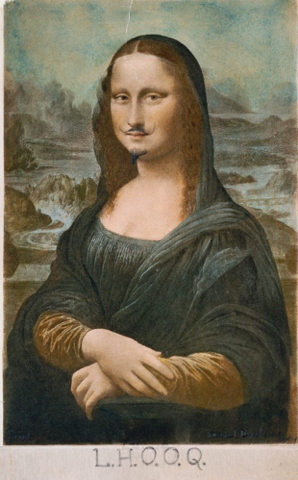
Another one of Duchamp’s famous contributions to the Dada movement was L.H.O.O.Q (Figure 3), which he produced in 1919. Another one of his ready-mades, this work is a postcard featuring Leonardo da Vinci’s Mona Lisa, a painting which was largely unknown outside of the art world until it was notoriously stolen in 1911 (PBS, 2009). The painting became an international sensation following this event and in the words of journalist John Lichfield is “the most visited, most written about, most sung about, most parodied work of art in the world (Lichfield, 2005).”