Bolivar and San Martin
- was a Venezuelan military and political leader who led what are currently the countries of Colombia, Venezuela, Ecuador, Peru, and Bolivia to independence from the Spanish Empire. He is known colloquially as El Libertador, or the Liberator of America.
- or the Liberator of Argentina, Chile and Peru, was an Argentine general and the primary leader of the southern and central parts of South America’s successful struggle for independence from the Spanish Empire who served as the Protector of Peru.
Encomienda
was a Spanish labour system that rewarded conquerors with the labour of conquered non-Christian peoples. The labourers, in theory, were provided with benefits by the conquerors for whom they laboured, the Catholic religion being a principal benefit in the view of the Spanish government. The Crown awarded an encomienda as a grant to a particular individual. In the conquest era of the sixteenth century, the grants were considered to be a monopoly on the labour of particular groups of indigenous peoples, held in perpetuity by the grant holder, called the encomendero, and their descendants.
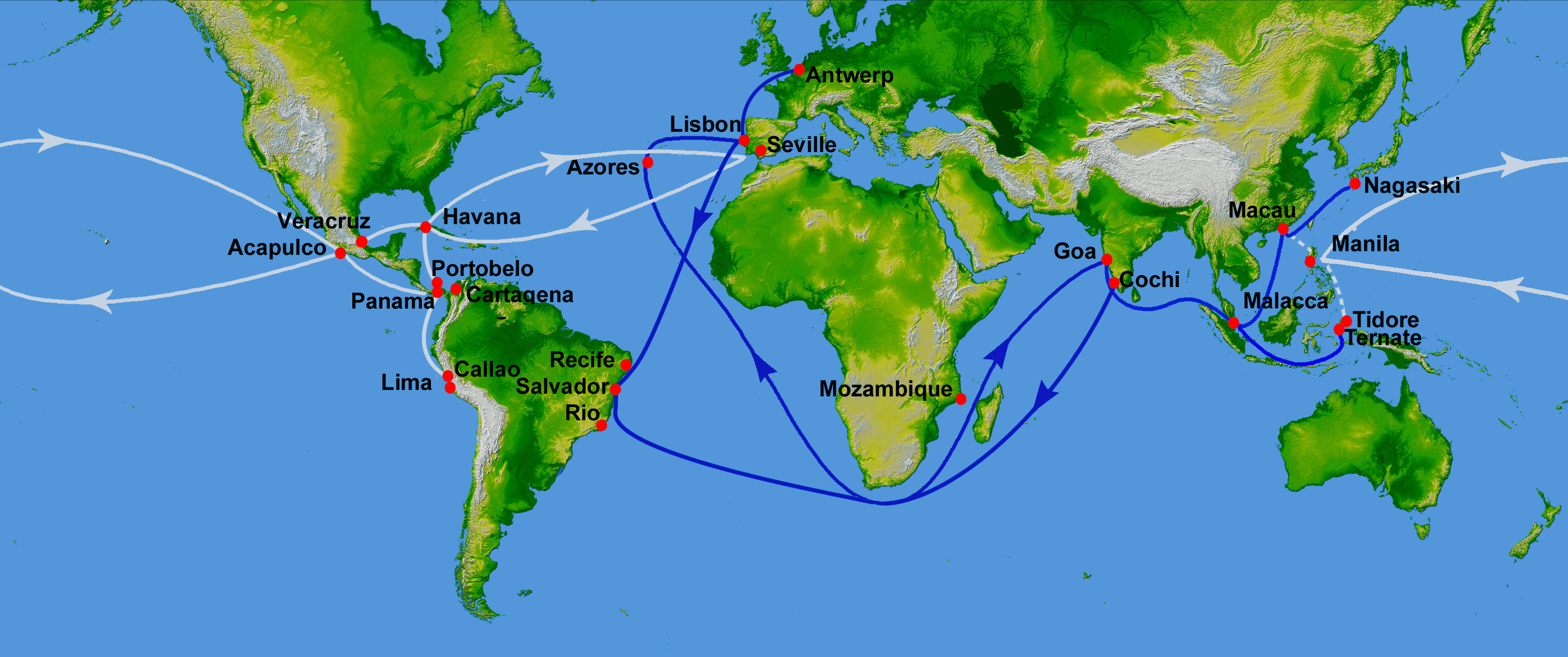
Spanish, Philippines, Mexico trade route
Trade with Ming China via Manila served a major source of revenue for the Spanish Empire and as a fundamental source of income for Spanish colonists in the Philippine Islands. Galleons used for the trade between East and West were crafted by Filipino artisans.[19] Until 1593, two or more ships would set sail annually from each port.[20] The Manila trade became so lucrative that Seville merchants petitioned king Philip II of Spain to protect the monopoly of the Casa de Contratación based in Seville. This led to the passing of a decree in 1593 that set a limit of two ships sailing each year from either port, with one kept in reserve in Acapulco and one in Manila.
- Spain’s route avoids Africa (Portugal controlled route)… took 4 months to go from Acapulco to Manila
- Selden Map, earliest surviving merchant map of East Asia, at least 1650
history Spanish