https://en.wikipedia.org/wiki/Age_of_Discovery 15th–17th centuries.
Three things stand out about the Age of Exploration: how capricious the map-drawing was, how venture-shaped the financing was, and how a single lucky capture could move a national treasury.
Two countries divide the world
The Treaty of Tordesillas (7 June 1494) split the entire non-European globe between Spain and Portugal along a meridian in the Atlantic; the Treaty of Zaragoza (22 April 1529) drew the matching anti-meridian on the far side.
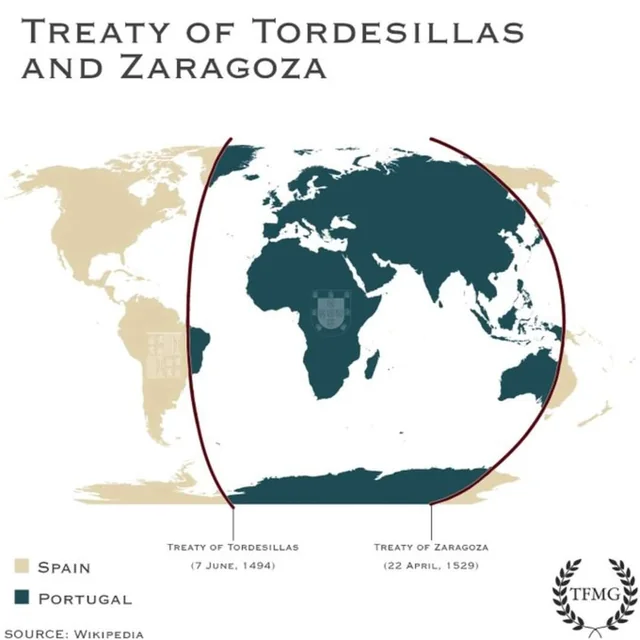
Two tiny European countries dividing a planet they had barely seen — most of the divided territory was unknown to both parties at the time of signing, and every other European power simply ignored the line.
Circumnavigation as proof of concept
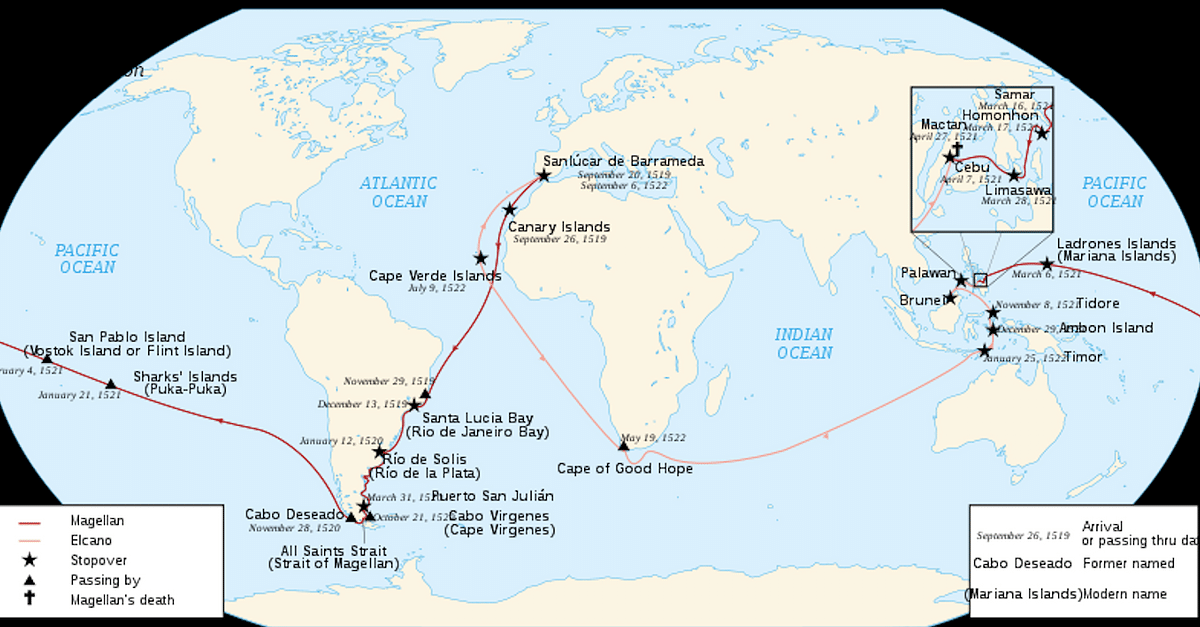
Magellan sailed from Sanlúcar de Barrameda in September 1519 with five ships; Elcano brought one of them back in September 1522, completing the first circumnavigation. Magellan didn’t make it — killed at Mactan in the Philippines, April 1521.
Whale hunting as a VC bet
Early whaling expeditions had a venture-capital payoff structure: enormous upfront capital (ship, crew, years at sea), a high chance of total loss, and a fat-tailed payoff if you came back with a hold full of oil and baleen. Investors spread capital across multiple voyages the way a fund spreads across a portfolio — one successful whaler could cover several lost ships and still return the fund. Exploration voyages were financed the same way: equity-like shares in a voyage, not debt, because nobody would lend against an outcome that binary.
The Madre de Dios: one ship, half the treasury
In 1592, English privateers captured the Madre de Dios, a Portuguese carrack of roughly 1,600 tons — one of the largest ships afloat — homeward bound from the East Indies loaded with spices, silks, gems, ivory, and other goods.
Even after massive pilfering by the crews before officials could inventory the cargo, it was valued at around £500,000 — roughly half of England’s entire treasury at the time, and roughly equal to the crown’s annual revenue. One hull, one lucky interception, and a national balance sheet moved by double-digit percentages. Hard to think of a modern equivalent: as if a single container seizure added half a year of federal revenue.
This was the real lesson of the age for statesmen: exploration wasn’t cartography, it was a lottery where a single ticket could rival the state itself — which is exactly why states kept buying tickets.